How to Start a Gratitude Journal (5-Minute Guide + 20 Prompts)

When was the last time you caught yourself thinking, "I'm glad that happened"? The bus showed up right on time. The sun came out. Someone picked up the phone when you needed them to. Those moments pass all day long, and most of them never stick. Your mind does the opposite: it nails the one thing that went wrong to your memory and lets the ten things that went right slide by.
A gratitude journal is a small, deliberate habit that evens that out. At the end of the day, you write down a few things that went well, on paper or on your phone. That's it. But behind the simplicity is an idea psychologists have been testing for years: what you pay attention to shapes how your life feels.
In this guide you'll find what a gratitude journal is, what the research does and doesn't show, a step-by-step answer to how to start a gratitude journal, and 20 prompts for the nights when you're staring at a blank page. If you're new to journaling in general, start with our post on the benefits of journaling. Start writing first, perfect it later: that's the whole method.
What is a gratitude journal?

A gratitude journal is a journal where you regularly write down what's going well in your life, what made you happy, or what you feel thankful for. The difference from a regular journal is the focus. A regular journal records everything; a gratitude journal deliberately looks at what's good.
"Gratitude" doesn't have to be religious or sentimental here. Think of it as noticing the value that a person, an event or a small detail adds to your day, and putting it into words.
There are two common styles:
- A gratitude list: You jot down a few things you're thankful for, bullet by bullet. It's quick and light.
- The "Three Good Things" exercise: You write three things that went well today and add why each one happened. It's a little deeper, and it's one of the most studied versions.
7 benefits of keeping a gratitude journal

1. It points your attention at what's going well
The mind drifts toward problems and threats on its own. A gratitude journal doesn't fight that; it adds a counterweight. Because you know you'll write tonight, you start noticing good moments while they happen.
2. It can lift your mood
Ending the day by writing down what went well closes it on a positive note. The clearest effect in the research is on positive feelings (see the next section).
3. It reminds you of your relationships
Most of the things people feel grateful for involve other people: the coworker who brought you coffee, the parent who called, your kid's laugh. Writing them down shows who takes up space in your life and often nudges you to say thank you.
4. It gives hard days some perspective
Even a rough day has a small bright spot in it. A gratitude journal doesn't deny the bad day; it keeps the day from shrinking into one bad summary.
5. It can make winding down easier
Closing the night with something that went well makes it harder to slide into a "what went wrong today" loop in bed. For a full bedtime routine, see Journaling Before Bed.
6. It builds a personal archive over time
Flip back through three months of pages and you'll find dozens of good moments you'd forgotten. It's a private "I'm glad" archive you can open on bad days.
7. It takes very little time
It's a habit you can finish before your coffee gets cold: five minutes a day is enough.
What does the research say?
The effect of writing about gratitude is well studied in psychology. Two studies are considered classics in this area.
Emmons and McCullough (2003). In the first two studies of "Counting Blessings Versus Burdens," participants were randomly assigned to one of three groups: one wrote about daily hassles, one about things they were grateful for, and one about neutral events or comparisons with other people. Logs were weekly in the first study and daily in the second. A third study ran with people who have neuromuscular disease. The gratitude groups scored better than the comparison groups on many, though not all, well-being measures, and the clearest effect was on positive feelings. (Emmons & McCullough, 2003)
Seligman and colleagues (2005). The "Three Good Things" exercise was tested with website visitors. Participants who got the instruction were happier right after the exercise, and the lift showed up at follow-ups one week, one month, three months and six months later (Seligman et al., 2005). The Greater Good Science Center at Berkeley summarizes the practice as writing in detail about three good things from your day, and why they happened, for about 10 minutes a day. (Greater Good in Action, Greater Good Magazine)
The exercise has reportedly been tried in other countries and groups as well: Israeli adults who wrote for five minutes a day for six days showed less pessimism and fewer negative feelings a month later, and Indian teenagers who kept a one-week journal showed improved well-being. (Greater Good in Action)
Let's be honest about the limits. The participants in the Seligman study were mostly white, college-educated, middle- and upper-income Americans, and more research is needed to know whether the results hold across groups and cultures. In the Emmons study, the effects also didn't show up on every measure. So a gratitude journal is not a guaranteed happiness switch. It is a cheap experiment with some scientific backing.
Greater Good also gives a practical tip: repeating the same things over and over can dull the effect, so detail and variety matter.
How to start a gratitude journal: 6 steps, 5 minutes
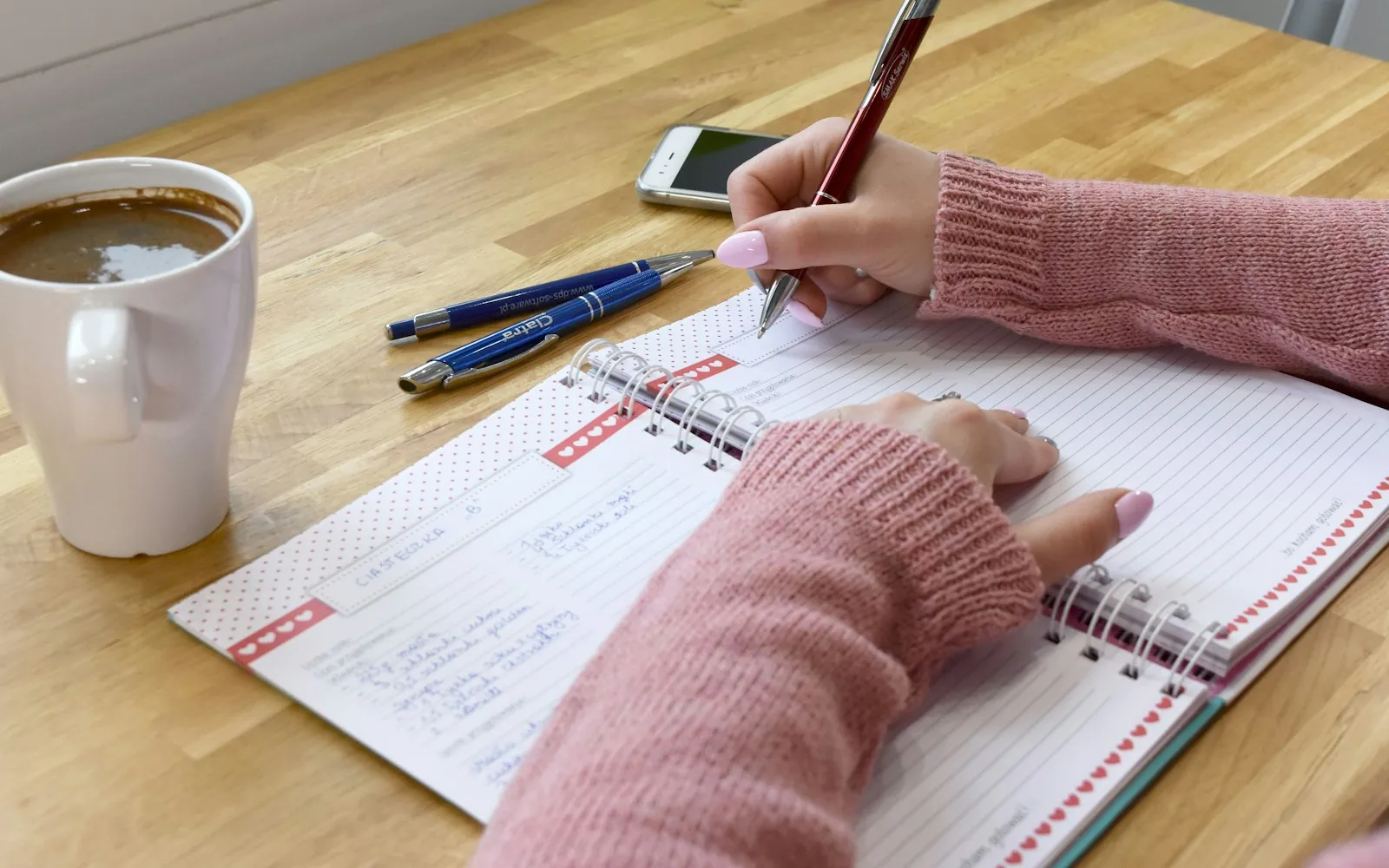
- Pick a time and a tool. Notebook or phone, it doesn't matter. The easiest move is to attach the journal to something you already do: after dinner, before you brush your teeth, right before bed.
- Keep the goal small: one to three things a day. Don't go past three in week one. Five-item lists feel exciting on day one and exhausting by week two.
- Add the "why." Instead of "I had coffee," write "I got to drink my first coffee in peace because I woke up early." The Greater Good Science Center builds the practice around writing in detail and thinking about why each good thing happened.
- Add detail. Where you were, who was there, what was said, how it felt. Detail turns a line into a memory with feeling in it.
- Include people. Make at least one item a day about a person: a conversation, a gesture, a message. Gratitude feeds on connection.
- Pause for three seconds after you write. Reread your last sentence and let yourself feel it for a moment. That's the real five minutes.
Daily or weekly?
Greater Good suggests the Three Good Things exercise daily, and a classic gratitude journal about once a week (five items at most). So both are valid. Choose whichever you like better; for a beginner, a short daily note usually sticks more easily than one long weekly page.
If you write weekly, you can also include past events and hopes for the future: what someone gave you last year, or what you're looking forward to next month.
Prefer to write at night? The routine in Journaling Before Bed fits a gratitude journal well.
What to write in a gratitude journal: examples and 20 prompts

Generic note vs. detailed note
| Generic | Detailed |
|---|---|
| I'm grateful for my family. | Mom called tonight and asked, "Did you eat?" Hearing her voice made the day's tiredness lift for a minute. |
| It was a sunny day. | I stepped outside for five minutes at lunch and the warmth on my face felt like a mini vacation. |
| My coworkers are great. | After the meeting, Jess said, "You handled that well." She didn't have to say it, but it meant a lot. |
Instead of listing the same things every day, writing one thing in detail keeps the effect fresh.
From your day
- What small thing made me smile today?
- Did something go right today that I didn't expect?
- What did I eat or drink today that I'm still thinking about?
- Is there something my body did for me today that I can thank it for?
- Was there a moment today when I thought, "I'm glad this happened"?
About people
- Who did me a kindness today?
- Who in my life makes things feel lighter just by being there, and when did I last thank them?
- Which conversation today is still warming me up?
- Who understands me and stands by me when things are hard?
- Whose message or gesture do I never want to forget?
Small details
- What was the most beautiful thing I saw today (a color, a smell, a sound)?
- What is something in my home or neighborhood that I've stopped noticing but am glad is there?
- What felt easy today that actually isn't?
- What did I learn today that I'm glad I learned?
- Was there a moment today when I was really kind to myself?
For hard days
- I struggled today, but what reminds me that I'm still standing?
- Even in this hard stretch, what gives me something to hold on to?
- What difficulty have I already gotten through that I'm thankful for now?
- Which of my strengths did this situation bring out?
- No matter what happened today, what small thing eased my mind this morning?
On hard days you don't have to say "everything is fine." A gratitude journal isn't about denying the difficulty; it's about being able to see the small good thing next to it.
Types of gratitude journals
| Method | How it works | Good for |
|---|---|---|
| Gratitude list | 1 to 3 items every day | People who want a quick start |
| Three Good Things | Three good things plus the reason for each, 5 to 10 minutes | People who want to go deeper |
| Weekly gratitude journal | Once a week, five items at most, with longer explanations | People who don't have time every day |
| Gratitude letter | A short letter thanking someone | People who want to strengthen relationships |
| Photo gratitude | Take one photo during the day, write a note under it at night | Visual thinkers |
Not sure which one? Start with Three Good Things, then mix in a weekly gratitude page after a few weeks.
5 common gratitude journal mistakes
1. Writing the same things every day
Copy "family, health, job" every night and the entry turns mechanical. Pick a different moment and a different detail each day.
2. Pressuring yourself
A page that says "I should be grateful" is a chore, not gratitude. You don't have to write something you don't feel. Small and true beats big and forced every time.
3. Writing only the good and skipping the hard stuff
A gratitude journal isn't rose-colored glasses. It adds a small good thing next to a bad day without covering the bad day up.
4. Trying to write too much
Long entries are exciting in week one and exhausting after that. Three sentences are enough.
5. Quitting after three weeks
The third week is when a new habit is most fragile. Shrink the goal that week ("one item a day") and set a reminder. If you miss a day, pick up where you left off the next day.
Frequently asked questions
What's the difference between a gratitude journal and a regular journal?
In a regular journal you write whatever is on your mind: worries, plans, anger, stress. In a gratitude journal you deliberately look at what went well, what lightened the day, or what you might otherwise have missed. They don't exclude each other. In DiaryOnce you can put your worries and your three good things on the same page.
How long does a gratitude journal take?
Five minutes is enough. Writing three items with one sentence of "why" each takes most people only a few minutes. You don't need to stretch it; consistency matters more than length.
How often should you write in a gratitude journal?
There's no single rule. Greater Good suggests Three Good Things daily and a classic gratitude journal about once a week. If you start to feel like you're repeating yourself, weekly can suit you better. If you skip a day, don't beat yourself up; pick it back up tomorrow.
I can't think of anything to write. What should I do?
Start small: a hot drink, a bus that came on time, or a friend's text all count. If you're still stuck, pick one of the 20 prompts above and answer only that one.
Should I write in the morning or at night?
Either works. Writing at night helps you wrap up the day and wind down; writing in the morning sets how you approach the day. Pick the one you can keep up. If you prefer evenings, try the routine in Journaling Before Bed.
Is it better to write by hand or on my phone?
There's no fixed rule. What matters is that you actually do it. Your phone is always with you, so for many people it's the more sustainable choice.
Is a gratitude journal a treatment for depression or anxiety?
No. It's a simple habit that may support your mood, but it doesn't replace treatment. If you've had a low mood or hopelessness for a long time, or anxiety that gets in the way of daily life, talk with a mental health professional.
Will it still work if I'm going through a really hard time?
You don't have to say "I'm thankful for everything," and forcing it can backfire. Write small, true things: even one thing that got you through today is enough. On days when you truly can't find anything, writing "couldn't find one today" is still a journal entry.
Conclusion: a small note, a different way of seeing
A gratitude journal isn't about ignoring the problems in your life. It's about continuing to see the good things that sit next to them. Three items, one sentence of "why," and five minutes are enough. Start today, look back at what you wrote in a week, and notice how it felt.
If you liked this post, check out these two too:
- Benefits of Journaling: what journaling does for your mind and your daily life
- Journaling Before Bed: a simple method for your evening routine
Keeping a gratitude journal with DiaryOnce
DiaryOnce is an Android diary app that gives you one page per day, which suits a gratitude journal well: one page is plenty for your three good things. A lined-paper look, 20 moods, a calendar, search and a streak counter make the habit easier to keep. Your entries stay only on your phone, you can lock the app with your phone's own lock, and past days can't be edited afterward, so every page stays an honest record of that day. You get reminders around noon and at night.
A note for US readers: DiaryOnce is in closed beta and is currently available in Turkish only. If you'd like to try it or have questions, write to support@diaryonce.com. App page: Google Play. Privacy policy: diaryonce.com/en/privacy.