Journaling for Anxiety and Stress: Research + 20 Prompts

It's 11:40 p.m. and your brain has called a meeting: tomorrow's presentation, an unpaid bill, a text you haven't answered, an argument you're still replaying. Everyone talks at once and nobody waits their turn.
Journaling for anxiety and stress is one way to move those thoughts out of your head and onto a page. Psychologists have studied the effects of writing about emotions and worries for decades.
In this post you'll find what the research does and doesn't show, the three writing methods used in studies, and 20 example journal prompts. If you're new to journaling in general, start with our post on the benefits of journaling.
Note: This post is general information. It is not medical or psychological advice and is not a substitute for treatment. Everything below is based on published research and on publications from health organizations, with each source linked.
What does the research say?

Expressive writing
The field traces back to James Pennebaker's 1986 study: college students wrote for 15 minutes on four consecutive days about the most traumatic or upsetting experiences of their lives, while a control group wrote about superficial topics. According to Baikie and Wilhelm's 2005 review, the standard method used in most later studies has people write for 15 to 20 minutes per session over 3 to 5 sessions, often on consecutive days (Baikie and Wilhelm, 2005).
The same review describes two meta-analyses: an analysis of 13 studies with healthy participants found a significant overall benefit (d = 0.47), and an analysis of 9 studies in clinical populations found a smaller but significant benefit for health (d = 0.19).
Naming your feelings
In a brain imaging study by Matthew Lieberman and colleagues at UCLA, putting a feeling into words reduced activity in the amygdala, a brain region linked to the threat response (Lieberman et al., 2007).
A to-do list before bed
In a Baylor University sleep lab study, people who spent 5 minutes writing a to-do list before bed fell asleep faster than people who wrote about tasks they had already completed (Scullin et al., 2018). We cover this study in more detail in Journaling Before Bed.
Writing about worries before a test
According to the University of Chicago, in Ramirez and Beilock's 2011 experiment college students spent 10 minutes writing about their feelings about an upcoming high-pressure math test. Those who wrote improved their accuracy by about 5%, while students who sat quietly dropped by about 12%. In a high school biology study, highly test-anxious students who wrote before the final averaged a B+, compared with a B- for highly anxious students who didn't write (University of Chicago).
Right after writing
According to Baikie and Wilhelm, right after writing about emotional topics, distress and negative mood usually rise for a short time, while at longer-term follow-up many studies have continued to find health benefits (Baikie and Wilhelm, 2005).
Limits
The same review notes these limits:
- Results for psychological health are inconsistent. Benefits tend to show up more often when traumas or symptoms are clinically more severe.
- Why the method works is still unclear, and the "get it out of your system" (catharsis) idea has little support.
- In some groups, writing was found to be harmful: in one study, adult survivors of childhood abuse, and in another, a small group of veterans with PTSD, did worse than the control groups.
- Most studies were done in labs.
- Writing can be used on its own or alongside traditional therapies; it isn't meant to replace face-to-face care.
3 writing methods used in research
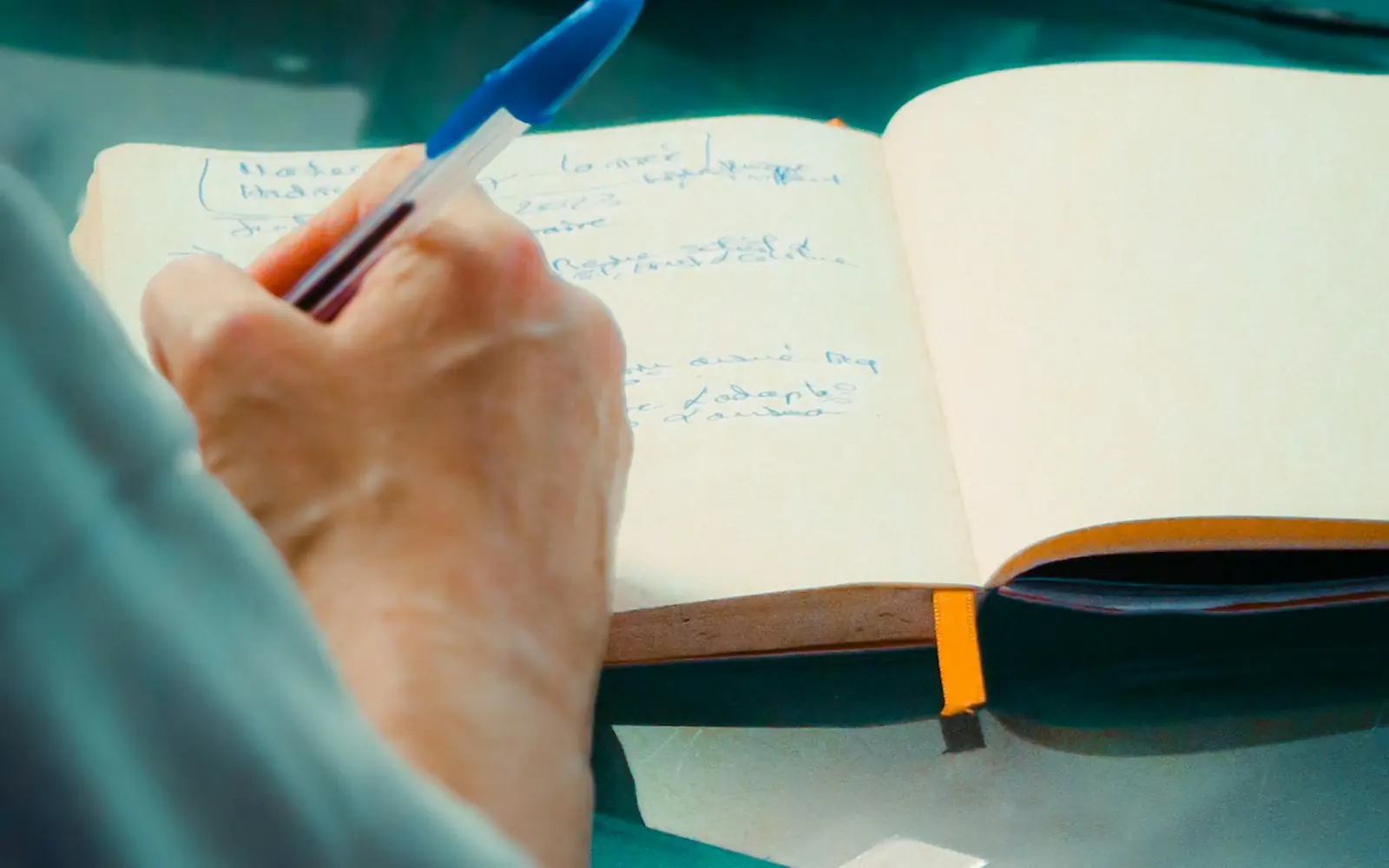
1. Expressive writing
In studies, participants were asked to write about their "very deepest thoughts and feelings," without worrying about spelling or grammar, and to keep writing until time was up. Baikie and Wilhelm recommend that in clinical use, sessions last no more than 20 minutes and people are told they can stop writing at any time (Baikie and Wilhelm, 2005).
2. Writing about worries before a big event
In Ramirez and Beilock's studies, students spent 10 minutes right before an exam writing about their thoughts and feelings about it (University of Chicago).
3. Reviewing a thought
A CBT-based self-help page from the UK's National Health Service (NHS) describes three steps: notice the thought, look at what evidence really exists to support it, and change it for a more neutral or positive one. The page also suggests a thought record with 7 prompts for examining the evidence (NHS: Reframing unhelpful thoughts).
Here's an example of how this can look on the page:
| Situation | Thought | A more balanced view |
|---|---|---|
| My manager said, "Can we talk later?" | I definitely messed up | Last time she said this, it was a small correction |
| My friend hasn't texted back | Did I upset them? | They might just be busy |
20 journal prompts

These prompts aren't a research protocol; they're example questions that can serve as a starting point on the page.
For your thoughts
- What's the loudest thought in my head right now?
- What did I think about today but didn't tell anyone?
- If I had to sum up what's draining me in one sentence, what would it be?
- If a friend told me this, what would I say to them?
- What do I want to stop thinking about by the end of this week?
For your feelings
- What's the name of the feeling I have right now?
- When did I first notice this feeling today?
- Where in my body do I notice tension?
- What was hardest today?
- Was there a moment today that felt good?
For reviewing a thought
- What evidence supports this thought?
- Is there any evidence that doesn't fit it?
- Is this thought a fact or an interpretation?
- Last time I had a similar worry, what actually happened?
- How else could I read the same situation?
For tomorrow
- What do I need to do tomorrow?
- Which of those things are in my control?
- What's one small thing that could bring me some relief this week?
- What has helped me before when things got hard?
- What sentence do I want to wake up to tomorrow?
What do health organizations say?

According to the National Institute of Mental Health (NIMH), with anxiety disorders the anxiety doesn't go away, is felt in many situations and can get worse over time, and symptoms can interfere with daily life and routine activities (NIMH). The UK's NHS advises seeing a doctor for people who think they might have generalized anxiety disorder, or who have been diagnosed and find that treatments aren't helping (NHS).
Frequently asked questions
Does journaling really reduce stress and anxiety?
It's not guaranteed. In Baikie and Wilhelm's review, people who wrote about emotional topics generally did better than people who wrote about neutral topics, but results for psychological health are inconsistent (Baikie and Wilhelm, 2005).
How long do people write in studies?
In the standard method, 15 to 20 minutes per session. The review recommends no more than 20 minutes per session in clinical use.
How many times do people write in studies?
In the standard method, 3 to 5 sessions, often on consecutive days.
Is it normal to feel worse after writing?
According to Baikie and Wilhelm, a short-term rise in distress right after writing about emotional topics is common, while at longer-term follow-up many studies have continued to find benefits. The review recommends that people know they can stop writing at any time.
Is a journal enough for an anxiety disorder or depression?
According to the review, writing can be used on its own or alongside traditional therapies, but it isn't meant to replace face-to-face care. Diagnosis and treatment are the job of health professionals.
What if I don't want anyone to read what I write?
In DiaryOnce, your entries stay only on your phone, and you can lock the app with your phone's own lock. Lockable paper journals exist too.
Conclusion: what the research adds up to
Research links writing about emotions and worries with positive outcomes for some people in some situations: naming a feeling reduced threat-related brain activity, writing a to-do list before bed was followed by falling asleep faster, and students who wrote about their worries before a test did better. The same research also shows that results are inconsistent, that writing was harmful in some groups, and that writing doesn't replace treatment.
You might also like:
- Benefits of Journaling: what journaling does for your mind and your daily life
- Journaling Before Bed: the research on writing before sleep
About DiaryOnce
DiaryOnce is an Android diary app that gives you one page per day, with 20 moods, a calendar, search and a streak counter. Your entries stay only on your phone, you can lock the app with your phone's own lock, and past days can't be edited afterward.
A note for US readers: DiaryOnce is in closed beta and is currently available in Turkish only. If you'd like to try it or have questions, write to support@diaryonce.com. App page: Google Play. Privacy policy: diaryonce.com/en/privacy.